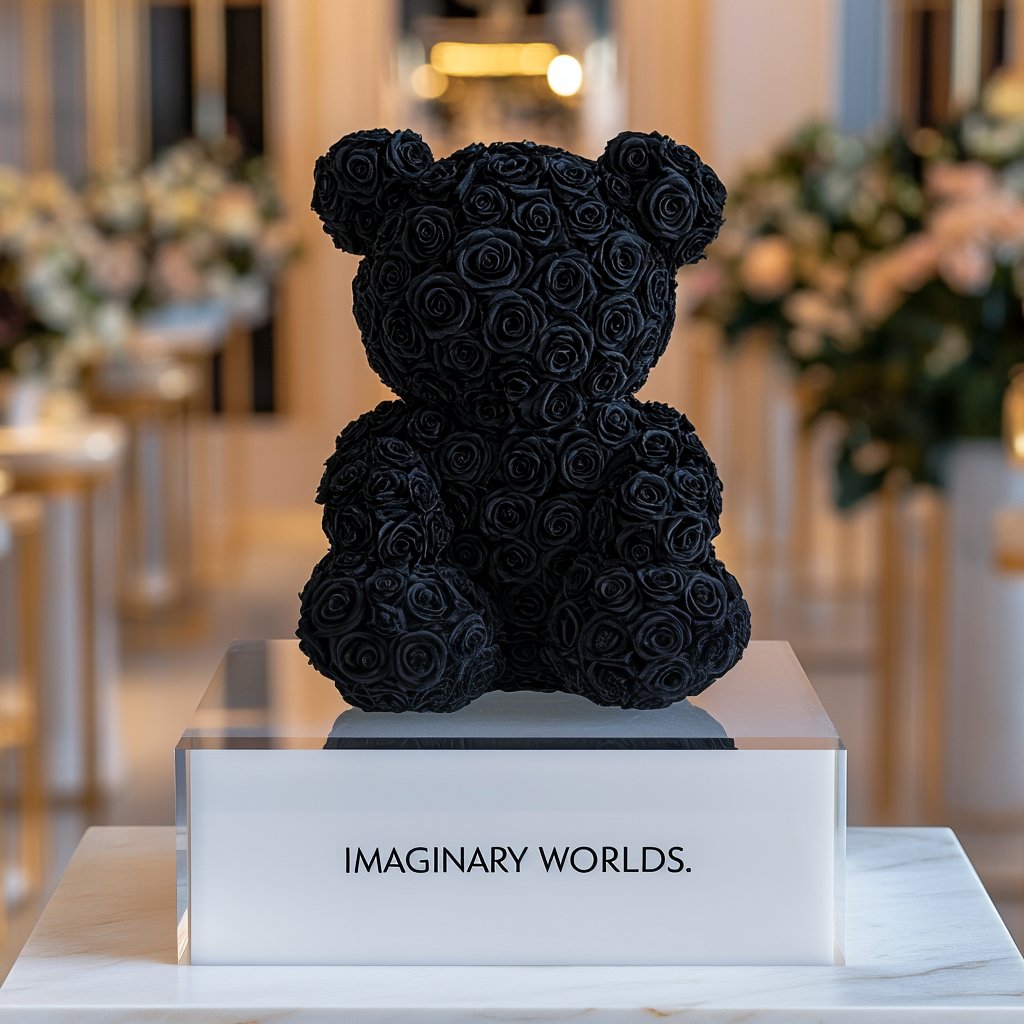
How structure, floral scale, silhouette, and light turn preserved roses into recognizable three-dimensional forms.
By Imaginary Worlds Editorial
Floral Art · The IW Journal
A sculptural rose lamp begins with a recognizable form, not with a bouquet placed beside a light. Preserved roses become the visible material over a structural core; the core controls the silhouette; illumination changes the object after dark. Butterfly wings, a rounded bear, pointed cat ears, a graphic face, an apple, and a detailed heart therefore present different design problems even when they use the same floral material.
The useful sequence is material, structure, form, and memory. The roses supply natural variation and repeated texture. Structure makes a three-dimensional outline possible. Form gives the object its identity. Light lets that identity move between floral surface and illuminated silhouette.
Collectible preserved rose sculpture
Silhouette comes before detail
A character form must read from several steps away before its small details are examined. Butterfly wings depend on bilateral balance and a clear outer edge. A rose bear depends on rounded head, body, and limb volumes. A cat needs sufficient scale for ears, face, and body outline to remain distinct. If the object is reduced too far, roses that look generous on a broad form can blur those transitions.
This is why a smaller version is not always a faithful version. Minimum physical scale is a design constraint. Where a reduced form loses the contour shown in its reference image, discontinuing that size can be more accurate than forcing every design into the same dimensions.
How six forms use floral structure
Butterfly
Bilateral symmetry and wing edges benefit from smaller rose heads that hold curves and points clearly.
Rose bear
Rounded character volume carries the familiar silhouette while the floral surface softens it.
Cat
Ears, face and body require enough physical scale to remain legible as one character.
Emoji
Graphic facial language must translate into a three-dimensional floral surface without losing the expression.
Apple
Broad rounded geometry accommodates fuller floral volume and a simpler, immediately readable outline.
Skull heart
The heart outline and graphic skull detail require denser edge control than a broad heart alone.
Rose-head size is an engineering choice
Detailed forms often use preserved rose heads around three centimetres across, while broader or simpler surfaces may use roses around four to five centimetres. These are approximate working ranges, not universal specifications. Actual bloom size varies naturally, and the appropriate choice depends on the physical model, the density required, and the transitions that must stay visible.
Smaller roses can trace a wing edge, an ear, or a graphic feature with more control. Larger blooms create broader floral volume with fewer interruptions. Neither is inherently more premium; each supports a different relationship between close-up texture and long-distance recognition.
Light belongs to the object
Illumination is not decoration applied to a generic floral sculpture. In daylight, color, petal texture, and construction lead. When the lamp is on, the outer contour becomes more graphic and gaps or changes in depth create shadow. A simple emoji face may stay bold, while a detailed character depends on careful separation between its features.
The surrounding room also matters. Wall color, ambient light, viewing distance, and placement affect how far the glow extends beyond the floral surface. Current product and collection pages should remain the source for verified electrical specifications, availability, and production timing.
Natural variation within a modeled form
A digital or physical model can control the underlying geometry, but preserved roses remain natural material. Bloom diameter, openness, petal edge, and color absorption vary. The maker selects and places roses so those differences contribute texture without erasing the intended silhouette.
That balance separates repeatable design from mechanical sameness. Two objects can follow the same structural model while retaining small, truthful differences in their floral surface.
Explore sculptural rose lamp forms
Begin with the Light Collection, then move to the character or signature silhouette that fits the intended object.
A character remains clear when floral scale serves the silhouette rather than competing with it.
Choosing character or signature form
Choose a character lamp when the recognizable figure—bear, cat, or graphic face—is central to the object. Choose a signature form such as butterfly, apple, or heart when outline and geometry carry more of the identity. In both cases, compare the physical scale and viewing distance rather than assuming every silhouette behaves the same way.
The full Light Collection is the broadest starting point. Each collection then narrows the choice to genuine designs within one structural family. Current collection and product pages remain authoritative for availability; a temporarily unavailable design can still be a genuine part of the design architecture.